Rethinking Progress

“Our main problem in the Christian life is not that we don’t try hard enough to be good, but that we haven’t believed the gospel and received its finished reality into all parts of our life.”


In the Twitterverse, a discussion started among friends and we’d thought we’d take it somewhere that would allow longer-than-140-character-interaction.

To get up to speed – read this phenomenal article from Tullian Tchividjian. Some excerpts:

“For a whole host of reasons, when it comes to measuring spiritual growth and progress our natural instincts revolve almost exclusively around behavioral improvement.

Every temptation to sin is a temptation, in the moment, to disbelieve the gospel–the temptation to secure for myself in that moment something I think I need in order to be happy, something I don’t yet have: meaning, freedom, validation, and so on. Bad behavior happens when we fail to believe that everything I need, in Christ I already have; it happens when we fail to believe in the rich provisional resources that are already ours in the gospel. Conversely, good behavior happens when we daily rest in and receive Christ’s “It is finished” into new and deeper parts of our being every day— into our rebellious regions of unbelief (what writer calls “our unevangelized territories”) smashing any sense of need to secure for ourselves anything beyond what Christ has already secured for us.

I used to think that when the Apostle Paul tells us to work out our salvation, it meant go out and get what you don’t have—get more patience, get more strength, get more joy, get more love, and so on. But after reading the Bible more carefully, I now understand that Christian growth does not happen by working hard to get something you don’t have. Rather, Christian growth happens by working hard to daily swim in the reality of what you do have. Believing again and again the gospel of God’s free justifying grace everyday is the hard work we’re called to.

In short, I spend way too much time thinking about me and what I need to do and far too little time thinking about Jesus and what he’s already done.”

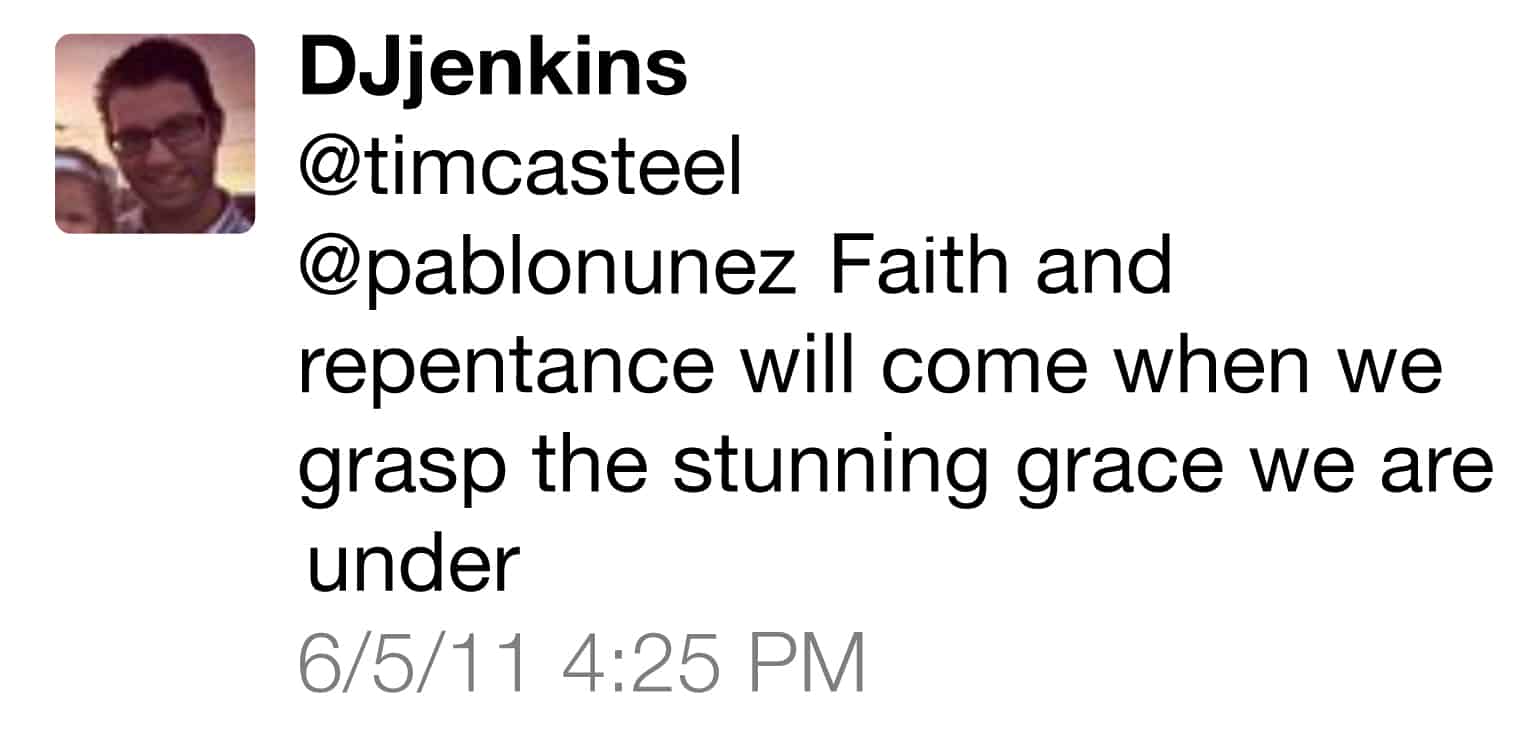
Here’s some of the Twitter discussion:

pablonunez
@DJjenkins @timcasteel I thought that article made some great points that are right on, but could it lead to a pendulum swing too far?
6/5/11 12:35 PM

pablonunez
@DJjenkins I guess I would like to hear how “godly grief that produces repentance” fits into his paradigm shift.
6/5/11 12:58 PM
timcasteel
@pablonunez @djjenkins He’s hitting on one side of the coin- faith. But not addressing the flip side- repentance of sin
6/5/11 4:07 PM

pablonunez
@DJjenkins @timcasteel right, so the pendulum swing I’m pushing back on is “don’t look at your sin- just look at how stunning grace is.”
6/5/11 4:48 PM

So what do you think?


  • http://andrewjwise.com Andrew

    I think the statement is true in the sense that any transformation in behavior that occurs in our life is based on something God has already graciously done in us. And so daily and moment by moment reminders of the work of Christ will fuel obedience.

    If I was asked what “our main problem” is in the Christian life, I would say our sinful nature; fleshly desires that lead us to think and act in ways that reject God. And I would say the solution is viciously battling those desires by reminding yourself of the indicatives of the gospel which should fuel obedience that demonstrates your faith.

    What I react against in the original statement is the impression some may get that you don’t have to “try hard” to reject sin and believe the gospel daily. It may be a “simple” matter, but it is not an “easy” matter – it is a war. So we should struggle and try hard to reject the desires of the flesh by reminding ourselves of the indicatives of the gospel and believing those promises as demonstrated by repentance and obedience.

    See: Galatians 5; Romans 6-8, etc…

  • timcasteel

    I agree Andrew – I think keeping the “main problem” in view is helpful. So the first battle to believe the gospel is in truly grasping the depth of my sin. I don’t think Tullian really addresses that.

    But I do think Tullian says we should struggle/try hard. In the comments of the article, Tullian replies to a commenter:

    “It’s comparably easy to spend our lives “making every effort” to address the fruit. It’s a war of worlds to spend our lives “making every effort” to address the root. Unbelief is the root. That’s the front line. That’s where we need to “make every effort.”

    So, it’s not whether fighting is necessary, or making every effort is necessary. Of course it is. The question is where is the front line of battle? That’s what I’m addressing.”

  • http://andrewjwise.com Andrew

    That’s a great quote, demonstrating that Tchividjian really does see it as an intense battle. I think I was reacting against the impression the original quoted statement creates. By setting “trying harder to be good” against “believing the gospel and receiving its finished reality” an unintentional perception might be created that “believing the gospel” does not involve “trying hard”. In fact, we should try very hard to be good if we are using those terms in a Christian way. But the manner and motive of our trying hard is believing and living the gospel, not self-righteously working for self-justification. And obviously, he clearly explains this later on in the article.

  • http://andrewjwise.com Andrew

    Again, I am not trying to say that Tchividjian does not think that believing the gospel requires a tremendous struggle. I am saying that that could be an easy misunderstanding that someone could get if they simply read the quoted statement based on the language that is used.

  • http://Website Paul Nunez

    Tim, thanks for posting this. I wanted to write out a more thorough explanation of the “red flag” i threw up.

    I think this IS a really good article and I actually don’t think Pastor Tullian said anything wrong. I’m pretty sure in my life I have a long way to go in grasping more deeply the magnitude of God’s grace for me and that is indeed the root of our sanctification.

    So my concern is how far do we take a statement like this “Forde rightly shows that when we stop narcissistically focusing on our need to get better, that is what it means to get better! When we stop obsessing over our need to improve, that is what it means to improve!”?

    Because my understanding of sanctification has been strongly shaped by 1John 1. “If we walk in the light a Christ is in the light, we have fellowship with one another and the blood of Jesus cleanses us from all sin”

    So what does it mean to walk in the light?

    “If we say we have no sin we deceive ourselves, but if we confess our sins, he is faithful and just to forgive us our sins and cleanse us from all unrighteousness”

    So my interpretation of these verses is that walking in the light involves to some degree a focusing on our self- an awareness of sin leading to confession.

    One author l like Jack Miller wrote a letter to missionary advising him not to spend more that 30 minutes confessing personal sin which would be over focusing on it. So that’s the balance I’ve always strived for which i think is present in Tullian’s use of words like “narcissistically focusing on self”.

    But because he wasn’t explicit, i would worry that taking a healthy (and necessary) amount of time to focus on your sin for the sake of confession and repentance could be considered narcissistic.

    Tim I think you summed it up will in your tweet “I’d say “look at your sin (and let that lead you) to look at how stunning grace is”

    Which i think is the point of John saying this:

    “I write this to you so that you would not sin, but if anyone does sin, we have an advocate with the Father. Jesus Christ the righteous one. He is the propitiation for our sins, and not for ours only but aalso for the sins of the whole world. ”

    Which I think Pastor Tullian would agree with?… I don’t know why, but I just couldn’t fully subscribe to everything he said… So this is my attempt to flush that out.

  • http://Website Paul Nunez

    Yeah i think that’s what’s setting off my “spider sense” about this article… some of the language could be misleading or set of an overreaction.

  • http://Website DJ Jenkins

    Great discussion guys, it is getting my head spinning around the gospel and sanctification, which is always a good thing! I have 2 thoughts:

    1) I think we might naturally underestimate our (sinful) tendency to default to works-righteousness (aka, Phariseeism). So when we read “make every effort” we naturally default to “ok let me pull up my boot straps and make sure I am good”. We don’t default to “man I need to dig down deeper and deeper into the gospel so I believe more what I already know”. I think we need radical statements like Pastor Tullian is doing to make sure we don’t default to works-righteousness.

    2) I am trying to think how much time I practically sit down and go, “Ok, now I am going to think about my sin”. I am not sure that is a good exercise, or one we should do. Usually, the deepest times of meditating on my sin have come after I feel the Holy Spirit has really convicted me (through preaching, another person calling me out, or my own reading of Scripture usually).

    In those moments of real conviction, most of the time I think my biggest danger is defaulting again to works-righteousness, but this time in the reverse. I tend to say, “Because I am this wicked and did this again, I am no good”.

    As I recognize that now, I am trying to identify more the root of my unbelief (what idolatry was I trusting in?) but the majority of my time now is focusing on the cross and what is true of the gospel so I am fighting my works-righteousness tendency with the reality of grace and the cross, which I find myself needing most.

    Anywho, that is how it usually goes down in my heart. Would love to hear your guys’ thoughts.

  • timcasteel

    Yeah, I would say in practice, I did/do not see the grace of God in Christ as amazing until I saw the depth of my sin. The biggest break through for me as a Christian has been really realizing how depraved I am. Realizing how desperately I need to be saved.

  • http://Website DJ Jenkins

    Here is another interesting article on accountability from Tullian. He goes after the same point but from a standpoint of accountability:

    http://theresurgence.com/2011/06/13/accountability-groups-the-tyranny-of-do-more-try-harder?utm_source=feedburner&utm_medium=feed&utm_campaign=Feed%3A+TheResurgence+%28The+Resurgence%29

  • http://andrewjwise.com Andrew
  • timcasteel

    Thanks for sharing those links guys – good articles.

    In this article Kevin DeYoung more directly addresses Tullian (and this post):
    http://thegospelcoalition.org/blogs/kevindeyoung/2011/06/14/gospel-driven-effort/

    What do y’all think about Kevin’s article?
    Because he addresses a lot of our questions/discussion.

    Some Quotes:
    “Tullian’s point is that sanctification requires the hard work of fighting to believe that we are justified by faith alone apart from anything good do or could possible contribute.
    I agree sanctification requires the fight of faith to believe this scandalous good news of the gospel of justification. I disagree that this is the only kind of effort required in sanctification.”
    “The New Testament gives us commands, and these commands involve more than remembering, revisiting, and rediscovering the reality of our justification. We must also put on, put off, put to death, strive, and make every effort.”

  • http://Website DJ Jenkins

    And here is Tullian’s final (I think) reply back: http://thegospelcoalition.org/blogs/tullian/2011/06/16/first-things-first/

    Personally, I am not sure I agree with the split Kevin is making about justification and sanctification. He says that sanctification is essentially “faith in the gospel + effort.” He says this because there are calls like “Let not sin reign in your mortal body” (Roman 6), as well as other appeals to our will and to do.

    But didn’t the apostles and Jesus makes these appeals to our will in their gospel preaching too? Jesus and the apostles many times said “Repent” and change their behavior, and “go and sin no more” all included in their gospel preaching, before people were converted. I see appeals to peoples will and changed behavior in preaching of the gospel to non-believers too.

    I think justification and sanctification are more close than Kevin is saying. I base this on Colossians 2:6-7, that says “AS YOU RECEIVED Christ Jesus the Lord, SO WALK IN HIM, 7 rooted and built up in him and established in the faith, just as you were taught, abounding in thanksgiving.” Paul THEN goes on to say how that faith should be lived out, by behaving holy and avoiding certain sins.

    But it seems, like in justification, the FOCUS is to be on “receiving Jesus Christ as Lord” as we first did, THEN the behavior of a changed life flows out of that. Once the gospel soaks in deeply, the calls to holiness and a changed life flow of that and make it comparably easy (as opposed to ‘get up and do something you lazy person’).

    I see Kevin’s line at the end of that article as problematic and a way of giving a “new law”. He says, “…some Christians are stalled out in their sanctification for plain lack of effort. They are lazy and need to be told so.”

    They are not just lazy, they are lazy for a REASON. There is SOMETHING ELSE that grips their heart more than the gospel, the beauty of Christ, all he has done for them and is in the gospel. You don’t change that through telling them “get up and do something.” You change that by getting them to see what the idol is they are trusting in and treasuring more than Jesus, then preaching to them how Christ and the gospel is FAR better than that.

    If you do that, THEN they will not be lazy, I believe. It may not happen all at once, but it will produce lasting, gospel change, I believe.

  • http://Website Paul Nunez

    Thanks DJ for posting Tullian’s response. That was helpful.

    I initiatally posted that I had some concerns with Tullian’s earlier post because it could cause a “pendulum swing”. The pendulum swing I saw happening was, that while imperatives need to flow out of indicatives, there could be a move to only talk about about indicatives. That by focusing on the indicatives only, we will be default live a holy life. Or said another way, by meditating on the Gospel, we need not meditate on our behavior. Meditating on the Gospel automatically leads to behavior change.. which I disagree with.

    For example, one of my old sunday school teachers took a passage in proverbs that talked about being careful about what we look at, the things we do, the people we do it with, etc… and said basically “we don’t need to worry about these warnings- we just need to focus on our relationship with God” – so he completely ignored the sound advice to be careful in specific ways (behavior)- which he did to avoid legalism- and only focused on the indicative of our relationship with God.

    But I really like how Tullian made the distinction that:

    “The law has the ability to reveal sin, but not the ability to remove sin. It points to righteousness but can’t produce it. It shows us what godliness, is but it cannot make you godly, like the gospel can. The law shows us what a sanctified life looks like, but it does not, in and of itself, have sanctifying power, as the gospel does.”

    So if I’m understanding him right- we need the imperatives to show us how to live godly lives, but only the Gospel gives us the ability to live it.

    In the proverbs example- those passages warn us specifically how to avoid screwing up, but the power to obey comes from the Gospel. My sunday school teacher was right to make our relationship with God the foundation for which we build the house of obedience, but was wrong to then ignore the specific teachings of how to be obedient.

    Recently I was reading in 1 Timothy Paul’s command to “immerse yourself in these things- devote yourself to them”, the next morning I read in Pslams “I made up mind to put no worthless things before me”. I was convicted by these passages about some of the wastefullness in my life. I needed these passages to show me that area of my life- but the power to change, the motivation comes from my free justification in Christ. So i need both the law and the Gospel to live a holy life. The law shows, the Gospel empowers.

    So i think in the end I too agree with Tullian and I agree that DeYoung’s last point ultimately shows that he’s not addressing the root of people’s problems- they are lazy cause they are not gripped by the person and work of Jesus Christ.

  • http://Website Paul Nunez

    I want to clarify something I said- I think my personal example is an interesting case study.

    The law showed me my wastefulness- but why am I wasteful? Ultimately I’m not believing in, being gripped by, the person of Christ and his kingdom. There is something more appealing to me than God’s promises. So the answer is not to say “I need to be less wasteful. The answer is, I need the Spirit to unite my heart by faith more and more deeply to the realities of the Gospel and eternity etc.

    So I do have a renewed motivating to be less wasteful. Where did that renewed motivation come from? Conviction from the Spirit. What gives me the ability to confront and own that issue? I’m freely justified in Christ. I don’t have to be ashamed of any sin in my life- like laziness and wastefulness. How will I overcome laziness and wastefulness? Ah- that’s the tough question. At this point I could say a couple things. 1 John 9 tells me by confessing He is faithful and just just to cleanse me. So there’s power in confessing and the Spirit begins to uproot that sin. But Tullian seems to be saying- that to overcome my laziness I need fight by the Spirit through faith to gain a deeper experience of God’s love for me in Christ.

    Alright gotta go- sorry this post was sort of a verbal processing one ;)

  • http://andrewjwise.com Andrew

    How do you think 2 Peter 1 adds to this discussion?

    His divine power has granted to us all things that pertain to life and godliness, through the knowledge of him who called us to his own glory and excellence, by which he has granted to us his precious and very great promises, so that through them you may become partakers of the divine nature, having escaped from the corruption that is in the world because of sinful desire. For this very reason, make every effort to supplement your faith with virtue, and virtue with knowledge, and knowledge with self-control, and self-control with steadfastness, and steadfastness with godliness, and godliness with brotherly affection, and brotherly affection with love. For if these qualities are yours and are increasing, they keep you from being ineffective or unfruitful in the knowledge of our Lord Jesus Christ. For whoever lacks these qualities is so nearsighted that he is blind, having forgotten that he was cleansed from his former sins. Therefore, brothers, be all the more diligent to make your calling and election sure, for if you practice these qualities you will never fall. For in this way there will be richly provided for you an entrance into the eternal kingdom of our Lord and Savior Jesus Christ.
    Therefore I intend always to remind you of these qualities, though you know them and are established in the truth that you have. I think it right, as long as I am in this body, to stir you up by way of reminder, since I know that the putting off of my body will be soon, as our Lord Jesus Christ made clear to me. And I will make every effort so that after my departure you may be able at any time to recall these things.

    (2 Peter 1:3-15 ESV)

    I see Peter telling them to “make every effort” (focus on) adding these qualities to the foundation of their faith (their justifying faith), while the motivation to do so is being cleansed of former sins (the work of Christ), realizing that the resources we need to do this have been given to us by God through our relationship with Jesus (“through the knowledge of Him”).

  • http://Website DJ Jenkins

    Paul, I think your distinction (from Tullian) helps clarify it perfectly.

    We have to have the imperatives to show us how we ought to live, but they give no power. Only the gospel gives power. So we have to share the imperatives, but show that the gospel alone is what motivates us to do those.

    I heard Keller has a simple outline for his sermon’s that goes like this:

    1) We ought to and have to live like X
    2) We fail to live like X because of whatever idolatry
    3) Christ perfectly lived out X for us and provides all the promises to live out X and died because we don’t live out X
    4) Look to Christ to live out X and defeat your idols

    That’s it more or less. It starts with the imperatives but he shows how we fail to do it, then leads us to Christ to do it.

    Great thoughts guys!