Tag Archive - Planning

Planning for Year 2023 – Step by Step Plan

Part 3 of a series on Planning for Year 2023 – click to read parts 1 & 2

“Without specific team goals, team members become confused and revert only to what they like to do or want to do. Goals that motivate always contain a ‘stretch element’ to them. In other words, they go beyond what you did last year and cannot be accomplished by simply plugging in last year’s methods and strategies. Most staff would rather fail at attempting something great than to succeed at something mediocre that just feels like failure.”
Eric Swanson

As a new staff, I always found the setting of our team goals to be rather arbitrary:

Team Leader: “OK, we had 50 coming to Cru last year, what should our goal be this year team?”

Staff 1: “I think we’ll have 75 this year”

Staff 2: “Why?”

Staff 1: “I don’t know – because 75 is a little more than 50?”

Staff 2: “Where’s your faith? Let’s add a zero! We’re going to have 500 this year!”

Staff 1: “You’re an idiot”

Staff 2: “No, I have faith”

Team Leader: “Ok, 60 it is.”

Staff 3 (me) texts to staff 4: “SMH” (that is, if we’d had cell phones back then)


So how in the world do you set goals that are full of faith AND realistic?

We’ve found the steps Jim Sylvester lays out to be very helpful. We rely VERY heavily on this model for our yearly goals. And it’s uncanny how accurate it has been for us, year after year.

At the end of his (119 page!) article Principles God Honors, Jim lays out a Step By Step Growth of a Movement.

Jim’s proven timeline has helped us set incredibly faith-stretching goals that are based in reality.


I’ll list out the years (with his descriptions of each year) below. A couple questions to ask yourself/your team:

  • What year are we currently in?
  • What should be our goals for this year be?
  • What will it take to make those goals a reality?


I would love to know – how does your team determine numerical goals?


Jim Sylvester’s Step by Step Growth of a Movement

His caveat: “This is merely a model from our campus at Ohio State. This is to he adapted to each unique campus. On a campus where Greeks are the most dominant social group, one would target Freshman Greeks very heavily. On our campus we found the dorms and RAs as the dominant social group, so we started there.”


Year One

  • Staff Team – Make sure staff team is on board in areas of ministry philosophy and commitment level.
  • Commitment – make sure staff are using their time wisely (i.e. 35 “hot hours”)
  • Reality is my friend. Time is my friend.
  • Working with students is messy. Since we are committed to working with students, we are willing to live with messy.


Year Two

  • Create a socially sharp atmosphere. Seek to bring leaders and other socially sharp individuals into the movement. Socially sharp individuals visible at meetings; make the atmosphere attractive and comfortable with quality activities. There has to be an atmosphere where men feel comfortable – AIA emphasis etc.


Year Three – Foundational Freshmen Class

  • These will be the leaders of the movement in 2-3 years. The entire movement is focused on the Freshman class.
  • Freshmen class of 80
  • This takes 120 Freshmen entering Freshmen studies in September
  • The gospel shared individually with about 1,500 Freshmen.
  • In the first 4 weeks, staff share Christ with 50 new students.
  • A student planned and student run movement


Year Four – Movement Maker Class

  • 80 freshmen who will return 40 strong as sophomores
  • 120 or more students attending weekly meeting.
  • Send 25 students on summer projects. (High percent from foundational class.)


Year Five – The Over-the-Hill class

  • 100 freshmen in discovery groups by the end of the year.
  • Cru meeting over 200.
  • Presence in all the dorms.
  • Movements starting in the Geek system, athletes, band, international students, and ethnic minorities.
  • 40 Students going on summer projects.
  • 40 + Students leading successful small groups.
  • Expansion campuses a major focus; they feel absolutely a part of the whole.
  • Hearts that pray – a prayer movement in place.
  • Ownership and love for the partnership country.
  • Students want and value training. 60-80 students come to training.
  • Student ownership runs deep.


Year Six

  • Win a Freshman class of 160
  • 300 people at Cru meeting.
  • 300 students involved in small group Bible studies.
  • Daily Prayer drawing 25 students; as large as 50 for Praise God Its Friday.
  • 50 students going on summer projects.
  • Students involved from every segment of campus.
  • Expansion campuses now flourishing, we’re now on 1 campus for every two of our staff.
  • A rich love for Jesus permeates movement.
  • Students are sacrificial for the cause.
  • Movement has a heart for laborers.
  • Praying for awakening and God’s hand in our movement.
  • Burdened for the lost and the needs of the world.
  • Model student leaders and spokesmen.
  • Students are captured by the campus vision & our potential for impacting the world.


Year Seven

  • 400 + at Cru.
  • 400 students in small groups.
  • Win a freshmen class that will return 100 involved sophomores (i.e. 200 freshmen in groups in April)
  • 60+ students going on summer projects stateside and worldwide.
  • Our expansion campuses have movements of over 50 and feel a part of the whole.
  • 10 seniors graduate and come on our staff or go on stint, 5 other students go into full-time ministry or seminary.
  • Continue previously mentioned health characteristics.
  • Major presence in the Greek system, with athletes, African Americans, Internationals.


Year Eight – The Saturation Freshmen Class

  • Win the Freshmen Class of 300 that will return 150 sophomores
  • Unless you are on a campus of greater than 40,000 students, this class will see the campus reach saturation before they graduate.


Year Nine

  • Win a freshman class of 400 (200 return as sophomores)
  • In every segment of the university
  • Totally visible throughout the university community.
  • Present in the areas of influence of this university.
  • 75 Seniors – 20% graduate into full-time Christian work, 100 jrs, 150 soph, 400 fish
  • Touching the world; laborers going to every culture.


Year Ten

  • A freshmen class that returns 250 sophomores
  • 80 seniors, 150 juniors, 200 sophomores, 500 freshmen
  • 200 students seeing multiplication
  • Impacting the entire State
  • Each of our classes is growing because evangelism is extensive throughout University
  • 100 students meeting daily for prayer


Year Eleven

  • 150 Seniors
  • 240 Juniors
  • 275 Sophomores
  • 600 freshmen (1265 in small groups)
  • Saturating Greek system, dorms, athletes, internationals, African Americans


Year Twelve – The Dream Come True

  • Cru: 1,000
  • 200 seniors, 250 juniors, 300 sophomores, 600 freshmen
  • 40 students going into full-time Christian work, 20 of those joining staff/going on stint
  • 80 graduating satellite campus students, 20 of whom go into full-time Christian work.


photo courtesy of Untitled blue 

Planning for Year 2023 – Goals Change Everything

Part 2 of a series on Planning for Year 2023 

Read part 1 to catch up on an intro to long term planning

Click to read part 3 – how to set faith-stretching yet realistic goals

Why does having a numerical goal (connected to a long term plan) change things?

1) It forces you to plan differently

2) It gives your staff and students hope/vision


1) It forces you to plan differently

What happens when you realize that you need to not just reach freshmen but need to reach 80 of them?

It forces your team to think in new ways – to try things you’ve never done before.

It takes “reaching freshmen” from an abstract idea/wish to a concrete reality that needs to be planned.

It makes you realize:

  • We’re going to need more than just our staff team of 3 in order to make this happen.
  • We’re going to need 20 freshmen Bible study leaders (paired up, leading 10 studies) in order to make that a reality
  • We’re going to have 120 in freshmen studies by the end of the fall in order to have 80 still in studies by the end of the spring
  • So we need to figure out a way to have conversations with 400 freshmen (if 1 in 5 will get involved in a Study)
  • So we’d better get in contact with 800 freshmen


2) It gives your staff and students hope/vision

Having numerical goals that fit into a long term plan turn ordinary, mundane tasks into vision-enfused opportunities.

Scope is demotivating if you don’t have a long term plan to accomplish reaching the entire campus.

It’s really depressing to constantly hear “we want to reach the whole campus, every single student with the gospel” and then look around the room and see you have 50 students involved. You don’t have to be a rocket scientist to realize that ain’t gonna happen this year.

But when your staff and students see a bigger picture for HOW we really are going to reach the entire campus, AND how their hard work this fall fits into that big picture, their work becomes meaningful, full of purpose.


Our staff and students need to know that we’re not just involving freshmen to make our name great, to enlarge the Cru kingdom. We have a long term plan to raise up enough equipped laborers that we will eventually share the gospel with every student on campus. I’ll only work so hard for an organizational vision, for Cru. But I will work tirelessly to spread His fame.


Tomorrow: How we set goals that aren’t arbitrary guesses about the future

(Hint: a 12 year step-by-step plan from Jim Sylvester has been enormously helpful)


How has having specific, faith-stretching goals forced your team to plan differently?

photo courtesy of danorbit

Planning for Year 2023 – Part 1

Part 1 in a series on Planning for Year 2023

“More happens in five years than you and I would ever dream.  Less happens in one year than we would ever hope. In building a movement, time is our friend.”

Jim Sylvester


Having a 12 year plan has transformed our ministry. 

The tendency in the fall is to plan the urgent.

There are fliers that need to be printed, rooms that need to be reserved, retreats that need to be planned.

But how does this fall fit into your long term plan?

A long term strategy keeps us from bouncing around to a different strategy every year.

We actually plan in 5 year chunks- in 2005 we set some goals for 2010. And this year we set goals for 2015. But it all fits into a longer-term, 12 year plan (more in a couple days, on “Why 12 years?”).

Every fall our strategy is the same:

  • Reach a progressively bigger freshman class
  • In order to build a bigger movement
  • In order to eventually reach the campus

We’re serious about reaching the entire campus with the gospel.

And we’re serious about doing it in a relational way (students hearing the gospel from a friend).

In other words, we’re serious about this vision:

“That everyone would know someone who passionately follows Jesus”


Of course everyone in college ministry is aiming to reach freshmen. But not all succeed to the same degree.

So “reach a bigger freshmen class” is not real helpful.


But for some reason, when you put a number on it, a goal, things start to change.

“We want to involve 40 freshmen this year in Bible studies”

And even more important is the overall context in which that numerical goal fits:

“We want to involve a freshman class of 40 this year, and next year we want to reach 80, and a couple years later 100, and eventually we hope to have a movement of the size and maturity to be able to TRULY reach every student on this campus.”


Why does something as small as a numerical goal for freshmen change things?

1) It forces you to plan differently

2) It gives your staff and students hope/vision


More thoughts on each of those tomorrow.


How would you sum up your long term strategy to reach the campus?

What have you found to be helpful in keeping a long term plan?


photo courtesy of Leo Reynolds

Biblical Planning

“What I would like to do here is to try to persuade you to set aside time each week in the coming year to plan—and specifically to plan your life of prayer and devotion and ministry.”


Some great admonition from John Piper from almost 3 decades ago: A New Years Plea – Plan!  The entire article is brief and well worth the read.

His assertion is that God’s spirit often arrives ready to work in us and he finds, due to poor planning, we’re not ready for him to work.

Here’s how I’m going to use the article in my initial discipleship appointments with my staff and students:

  1. First: Work thru the verses on planning that Piper lists out (thru Proverbs and the example of Paul) and help my staff/students come to the conclusion that Piper draws from Proverbs: “Careful planning is part of what makes a person wise and productive. Not to plan is considered foolish and dangerous.”
  2. Second: Have them map out a plan for the semester – especially focused on their walk with God and their ministry. Do this using the example of Paul as drawn out by Piper: “He had a general guideline: he wanted to preach where no one had preached before. Then he developed a specific plan from this guideline”.  Application- “OK Joe Staff.  You want to launch a Bible study in that dorm and lead guys to Christ.  What do you need to do first?  Then what? How are you going to work that into your schedule? When will you spend time there?”
  3. Third: Have them map out when they will plan every week specifically for ministry for the following week. To look ahead to the coming week and set up appointments, plan discipleship and Bible study material, etc..  For us, it will probably be Friday afternoon.


Another great application point for those of us on Staff with Campus Crusade:

  • As staff we get to take an entire once a month to spend with God.  Piper expects that his staff would use that day to plan their spiritual lives.  For some reason I’ve never thought about using my day with the Lord in that way – planning.  I always use it devotionally and often reactively – just catching my breath spiritually (if that makes sense).  What if we used that day proactively to plan out our spiritual well-being for the month so that every day/week would be fruitful.


What have you found helpful as you plan and help others plan their ministry/devotions?


photo courtesy of koalazymonkey

Buckets and Holes Planning

Planning is honestly one of my favorite times of the year. We do serious planning (5 days, 9-noon) three times a year: August, December, May.  Love it.

To use Stephen Covey’s metaphor, we spend the entire year climbing furiously up the ladder – planning is a time to make sure our ladder is leaning against the right wall.

We start our week long staff planning this morning. So here’s some planning-themed inspiration to help you get ready.

The most practical advice I’ve heard in the past few years came from Tim Henderson who leads the Cru ministry at Penn State (Tim and his team put out incredible resources under the name Centerfield Productions).


I call it Buckets and Holes. I’m sure Tim Henderson has a more official name for it than that.

Here’s how Tim puts it: “How do we spend what we have to solve our problems, meet our goals, and increase what we have for next year and its problems?”


Here’s the (abbreviated) idea in two parts (the second one, for me, was the new insight).  For your ministry, for this year:

  1. What are the holes/problems (this step is common for most strategic planning)?
  2. What are the buckets we have to draw from?  What do we currently have that we can use to solve those problems?

Fleshed out, here’s what that looks like for us this year:

  1. Hole: our leadership numbers at our weekly training time have plateaued over the past few years.  If we want to reach the entire campus, we need more equipped laborers.
  2. Buckets: Our weekly meeting is not a problem to be solved.  It’s a giant bucket of cash.  We’ve got great momentum and incredible student leaders attending who love Jesus.  So we plan to use our weekly meeting to address our Laborer Hole.  A few other buckets we plan to use: we have a lot of great students leading Bible studies; we have a lot of students who choose to live in the dorms to have a ministry.

The Goal = To turn your holes into buckets. In 2011, we hope to be able to see that laborers is no longer a problem but a bucket that we can draw from to address the inevitable holes of 2011.

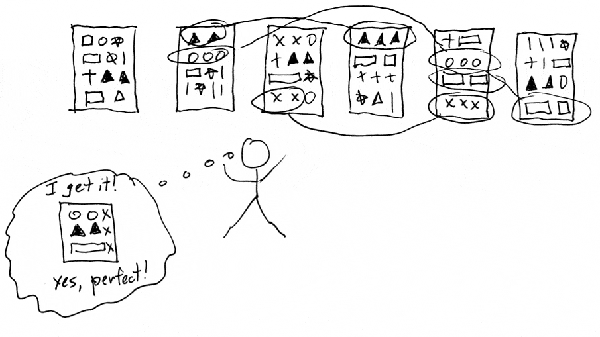
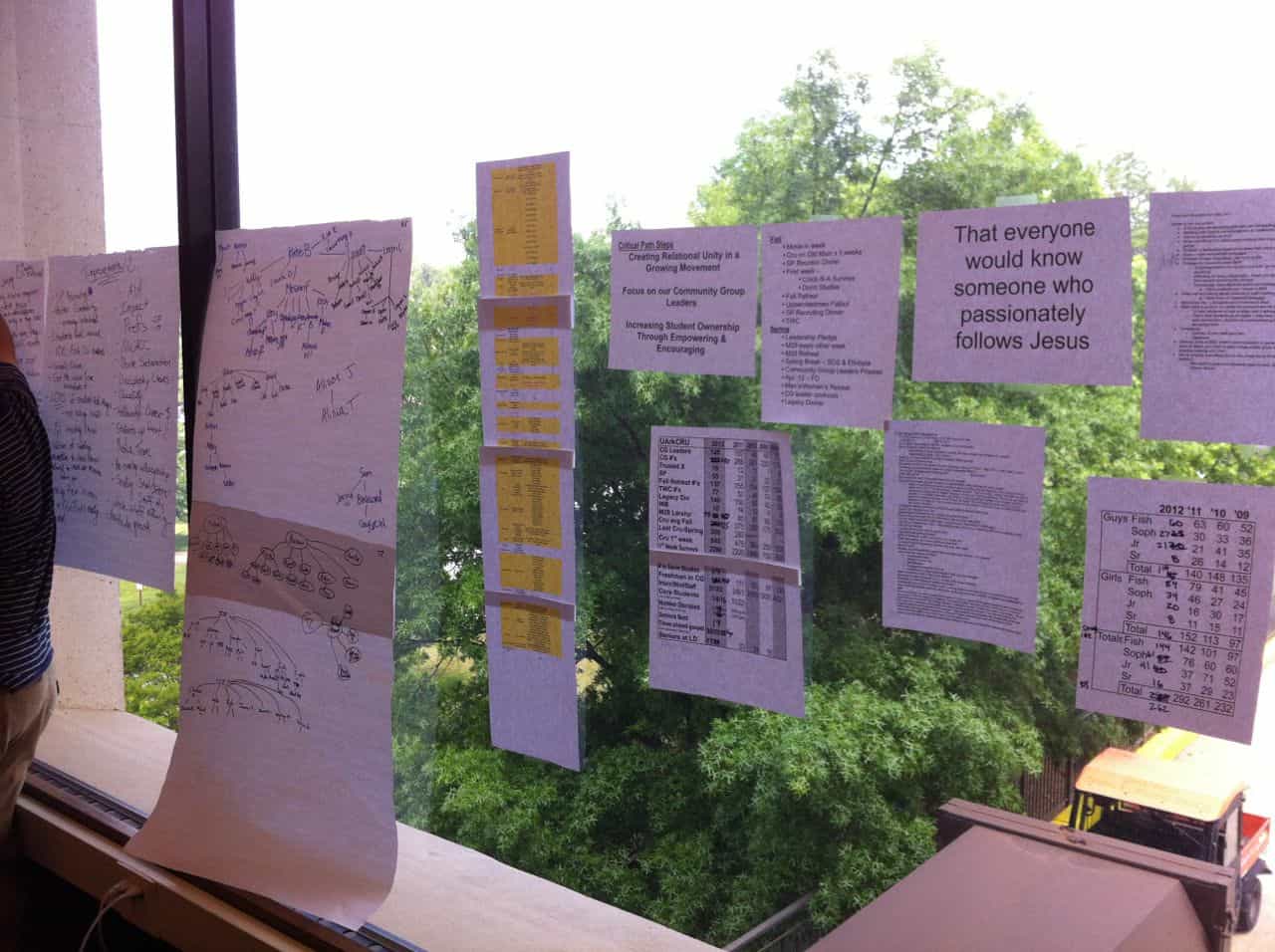
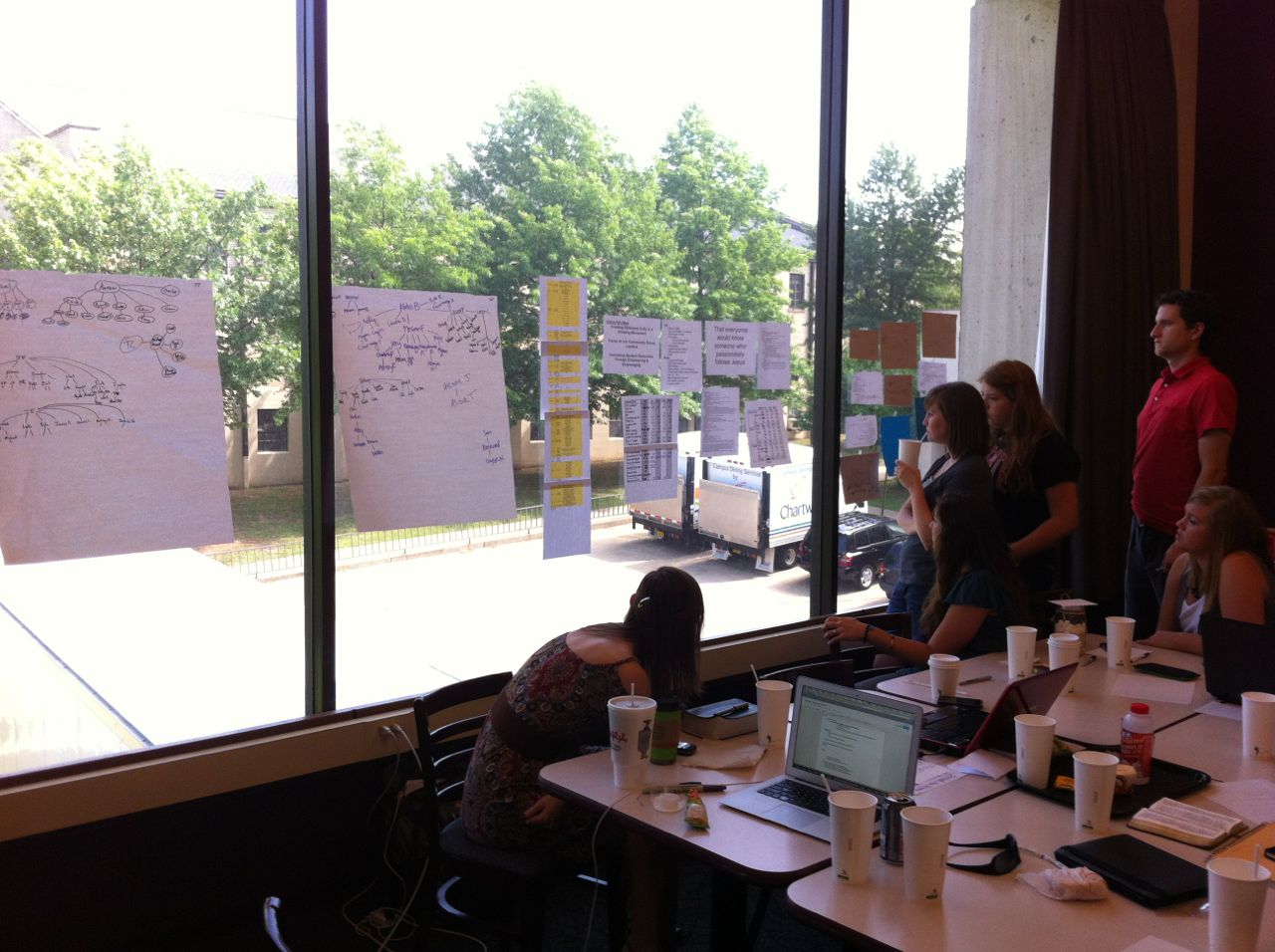
So we spend an entire hour during planning filling out two big post-it posters on what our Holes and Buckets are.  We narrow it down to 3-4 Holes we will tackle this Fall and then start playing connect the dots, connecting Buckets with Holes.


There’s actually 4 steps to the entire process and this PDF from Tim Henderson shows a very clear overview of the full process (right click to download):

Download (PDF, 104.81KB)


Some Bonus Planning Quotes to get you fired up about planning!

Simple, clear purpose and principles give rise to complex and intelligent behavior. Complex rules and regulations give rise to simple and stupid behavior. – Dee Hock

You’ve got to think about the big things while you’re doing small things, so that all the small things go in the right direction. — Alvin Toffler

The best way to get a good idea is to get lots of ideas. — Linus Pauling

photo courtesy of rubyblossom via flickr