Tag Archive - Facebook

Weekend Links 1-21-11


This article has an interesting prediction on Twitter and Facebook.  I tend to agree:

Twitter and Facebook are no longer both general social networks.

My prediction is that Twitter will become a platform where you can connect with some people in their professional lives, and Facebook will continue to be the platform where you can connect with most people in their personal lives.


This is fun and interesting – The United States of Surnames (via Alltop)

National Geographic has put together an interesting map showing the popularity of surnames in different parts of the United States. Each surname is color coded to indicate origin and the font size relates to number of people with each surname per state.


Great thoughts from Ben Arment – It’s Okay to Say No


Who doesn’t love a good infographic? I thought this one was interesting – Fed Ex vs. UPS – (via Challies)


And since, like me, you haven’t watched any soccer since the World Cup we’ll end with this – some unfathomable soccer ineptness:


Weekend Links

I’m trying to ease myself back into this Blogging thing. So we’ll start with some Weekend Links.


We could all learn a lot from John Piper. But, in my opinion, one of the best things we can learn from him is brutal honesty in confessing his sin. Piper’s report on his leave of absence (via Justin Taylor) is striking in its honesty in revealing his deep heart sins (specifically in his marriage).  Read the whole thing here.

“I would label my decades-long, besetting (and I hope weakening) sins in this relationship as selfishness, self-pity, anger, blaming, and sullenness (all of them species of pride). There are others, but these are close to the root of our troubles.”


As Ken Cochrum tweeted: this is “required reading for anyone serious about online ministry: the future of connections”
Time Magazine – Person of the Year – Mark Zuckerberg

An utterly fascinating, and surprisingly deep, article.

Relationships on Facebook have a seductive, addictive quality that can erode and even replace real-world relationships. Friendships multiply with gratifying speed, and the emotional stakes stay soothingly low; where there isn’t much privacy, there can’t be much intimacy either. It’s like an emotional Ponzi scheme, where you keep putting energy in and getting it back tenfold, even though the dividends start to feel a little fake.

For all its industrial efficiency and scalability, its transhemispheric reach and its grand civil integrity, Facebook is still a painfully blunt instrument for doing the delicate work of transmitting human relationships. It’s an excellent utility for sending and receiving data, but we are not data, and relationships cannot be reduced to the exchange of information or making binary decisions between liking and not liking, friending and unfriending

Facebook is the bottle, and we’re the genie. How small are we willing to make ourselves to fit inside?


Another very insightful article – Andy Crouch’s The Ten Most Significant Cultural Trends of the Last Decade

#1 – Connections: “What did not take off in the 2000s was “virtual reality”—a world constructed entirely of disembodied bits, populated by avatars and existing only in the realm of the ideal. As the 2000s ended, the virtual-reality world Second Life was on virtual life support.  Instead, we used technology to reinforce our embodied relationships.”

#4 – The End of the Majority – “White Americans were still a bare majority of the population by the end of the decade, but in delivery rooms they were already only a plurality (the largest of many minorities).  We are all minorities now.”


2010 was a year rife with bad Logo makeovers, here’s the Worst Logo Makeovers of 2010 .  Here’s the Best.


The following news was mind blowing to me. How did I miss the memo that you aren’t supposed to put two spaces after a period?

Why you should never, ever use two spaces after a period.

Facebook 5x better than Twitter?

I like Twitter about 1000x more than Facebook.

Like Brian Barela quoted on his blog: “Twitter makes me like people I’ve never met and Facebook makes me hate people I know in real life”.

I use it as an all-in-one:

  • Feed reader (letting me know when my favorite blogs update)
  • News Aggregator (NYTimes, CNN, CollegeFootball)
  • Devotional (gospel-centered content throughout the day from guys like @PastorTullian and @PaulTripp)
  • Leadership-Developer (short bursts of leadership genius from the likes of @MichaelHyatt or @ScottBelsky)
  • AND Friend-updater (the one feature Facebook is good at)


But when I link to my blog in my Facebook status I get 5x more traffic then when I just get the word out via Twitter.

Matches up pretty well with this interesting Fast Company article: “Facebook Is Worth $2.52, Twitter Only 43 Cents” and the fact that Facebook has 5x as many Users (and I have 5x as many “friends” there!).

A primary reason why Facebook continues to dominate?  Ease of use.

Have you ever tried to explain Twitter to someone new?  What are hashtags? What does RT mean?  What’s bit.ly?  Where’s the insert photo button?

37Signals blog states it well:

Some serious flaws are holding Twitter’s usability back. A collection of hacks that were initially cool and clever among the geekset have turned into de facto features. Why should users have to know what a URL shortener is? Why does attaching a photo to a tweet require third-party tools and diminish your character count?

Related back to college ministry. . .

What are we unknowingly doing that prevents new people from understanding our ministry and wanting to “Sign On”.  
What do we need to do to make our ministry, in the words of 37Signals, “easier to use, easier to explain, and easier to expand”?

To Start:

  • Hashtags = getting rid of insider Christian lingo
  • URL Shortener = Bulit-in ways to help students take the next step (clear map of what it looks like to get involved past the weekly meeting)

What would you add?


photo courtesy of abraham.williams via flickr

Weekend Links

  • I remember reading this prophetic article in Time Magazine over 2½ years ago that asked “Is Facebook the Future of Search?“.  It made a good case:

“On Facebook, we don’t have to seek information. Instead, information just comes to us.  The future of search: I don’t just want the information faster, I want it before I even ask for it.”

Last week, with the Facebook-Bing alliance, that future became NOW.  Great article from Fast Company on what this alliance means for all of us.

A couple important points: 1) If your website isn’t getting “Liked” on Facebook, it won’t show up in searches, and 2) You should go check your Facebook Privacy settings

  • Travelocity, Orbitz, and Kayak are so 2001.  Mint.com shares which new travel websites alert you when particularly great deals become available out of your local airport and predict what airfares will look like in the near future so you can adjust your travel plans accordingly.
  • It is mind-blowing how big Africa is.  Check out this amazing map that shows how it’s bigger than the USA, China, India and all of Europe COMBINED!
  • Donations to the top charities dropped 11% this year – the worst decline since they started tracking giving
  • And check out this cool video from David Crowder.  Easily the best Christian music video I’ve seen (Except for maybe Michael W Smith’s Secret Ambition video).

Go where students are – Facebook Fan Page


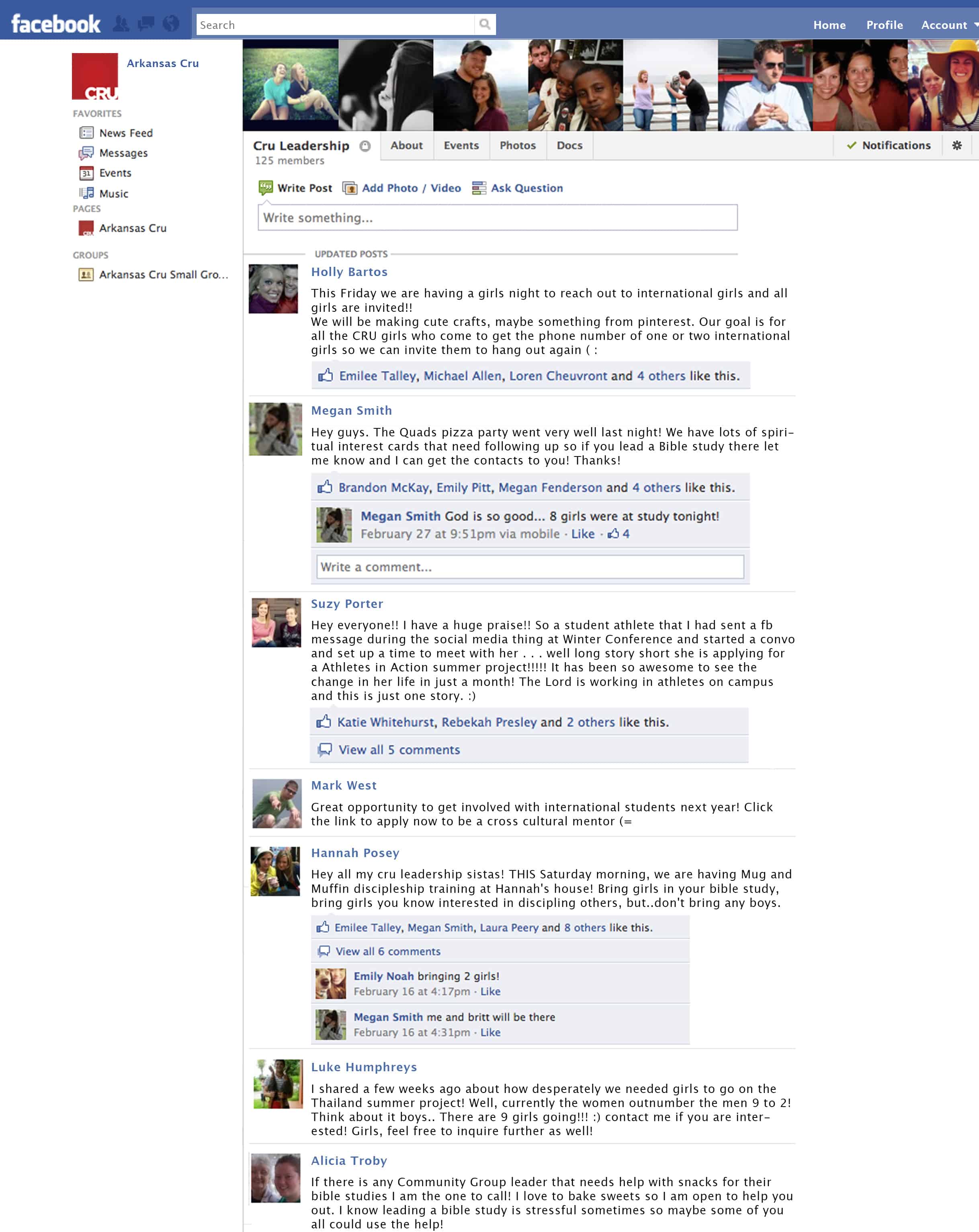
The best new outreach idea we’re trying for the fall is Facebook. You may have heard of it.

Outreach by definition is an effort by an organization to connect its ideas to the general public.

You take your ideas to the audience.

And where is our audience?  On Facebook!

We’ve done quite a bit with Facebook in the past – advertising, Cru group, events, etc.

But a Facebook Fan Page is a whole ‘nother deal.

First off – you should subscribe to Brian Barela’s blog (click here for an explanation of the life-changing discovery of how to subscribe to blogs).  You would know all this stuff already if you read his blog and another blog he contributes to: mediaforministry.org


This is our strategy this fall as we meet freshmen (courtesy of Brian Barela):

  • Add them as a friend on Facebook
  • Click the “add a message” box
  • Write something like this: “Hi this is Tim from Cru – you filled a card expressing interest and I just wanted to invite you to come to Cru on Tuesday at 8:30.  Please also join our fan page: Facebook.com/ArkansasCru”


Before I start, let me shoot down your main excuse (at least it was mine):

  • “I don’t know anything about setting stuff up on Facebook and I don’t have time right now to learn” – I had a student set it up (I attached below the email I sent out to solicit help- just copy and paste!).  I guarantee you have a student who would be willing and able to do it.


First the Why’s, then the How’s:
Why?

  • Facebook is where students live.  Go where students are.
  • It’s free.  We all know advertising isn’t cheap.  But thru a Facebook Fan Page you can “advertise” your events on a site where 99% of your target audience spends hours every day
  • It’s interactive – students can comment and ask questions.
  • You can get a custom URL for free (website name): facebook.com/ArkansasCru
  • Fan Pages are way more “viral” than Groups.  So we’re shifting from a Facebook Group to a Fan Page.  Check out this informative video explaining why from Brian Barela.

And best of all: It’s pretty easy to work the system (by “liking” the fan page, commenting on it, etc) to where your Cru Fan Page will show up on the News Feed of anyone your students are friends with.


How do you set one up?

  • Here’s a step by step video on how to do it (from Brian Barela again!).


We watched this video in staff meeting yesterday – it builds a great case for why we HAVE to engage in social media:

Here’s an email you can adapt to solicit help from students.

Download (DOC, 34.5KB)